
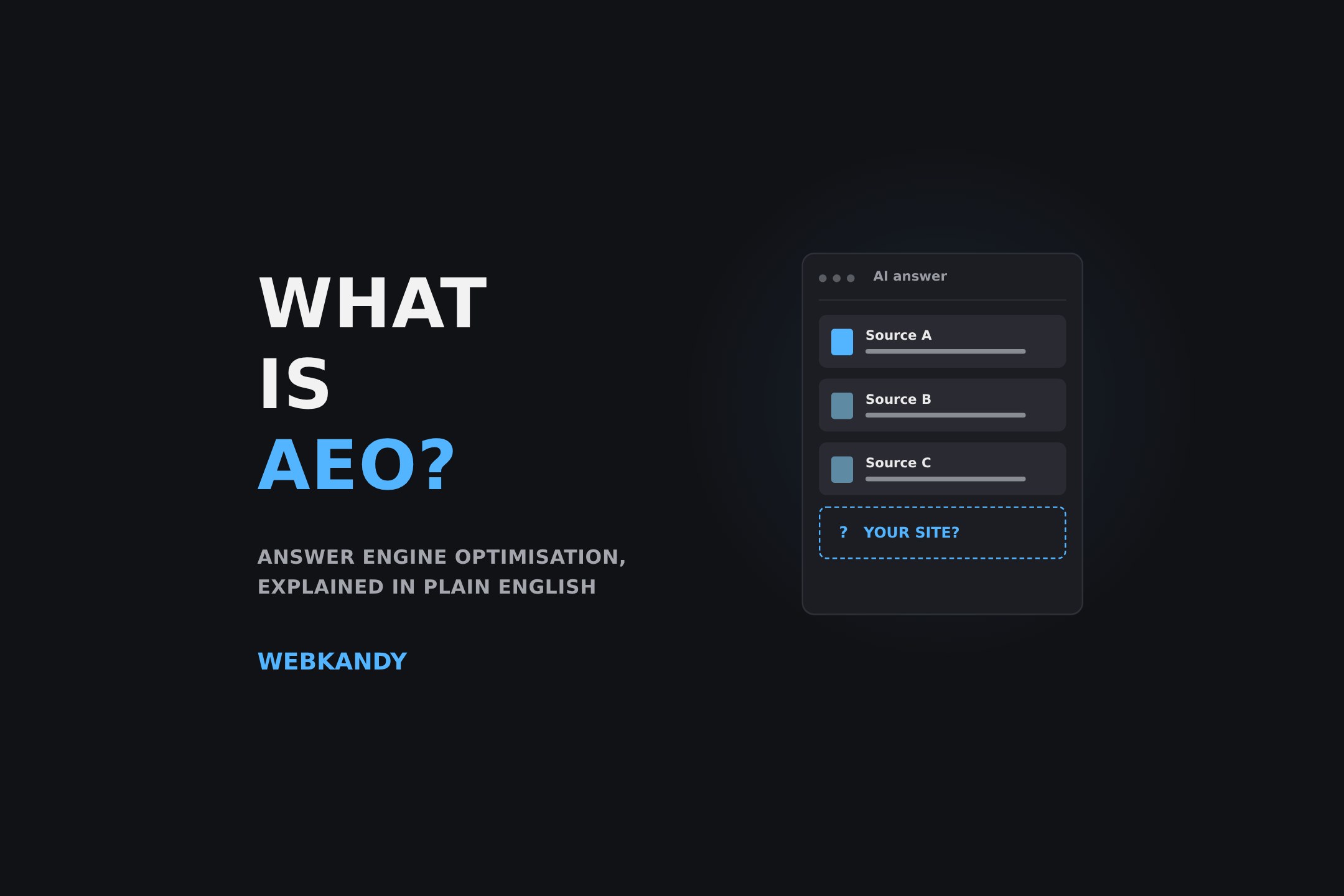
What Is Answer Engine Optimisation (AEO)?
Google now answers questions before anyone clicks. ChatGPT is a search engine. Perplexity has millions of daily users. If your content isn’t built to be chosen as the answer, you’re invisible to a growing chunk of your audience, and you don’t even know it.
In this guide
The short version
- AEO is structuring your content so AI platforms (Google AI Overviews, ChatGPT, Perplexity, Gemini, voice assistants) select it as the direct answer.
- SEO was about being found. AEO is about being chosen.
- 68.01% of US Google searches ended without a click in early 2026.
- AI engines favour direct answers, E-E-A-T, structured data, topical authority and domain trust.
- Strong SEO is a prerequisite for AEO, not something it replaces.
What is AEO (Answer Engine Optimisation)?
Answer Engine Optimisation (AEO) is the practice of structuring your content so that AI-powered platforms, including Google AI Overviews, ChatGPT, Perplexity, Gemini and voice assistants like Siri and Alexa, select it as the direct answer to a user’s query.
Where traditional SEO focuses on ranking in a list of ten blue links, AEO focuses on being the one answer that gets read out, displayed or cited. The goal shifts from “rank on page one” to “be the source the AI trusts”.
Think of it this way. When someone types “best time to post on Instagram in 2026” into Google, they increasingly don’t see ten links: they see a single AI-generated paragraph. That paragraph was pulled from somewhere. AEO is the discipline of making sure it’s pulled from you.
SEO was about being found. AEO is about being chosen. They’re related disciplines, but they’re not the same game.
The term covers several overlapping practices: optimising for Google’s Featured Snippets, building content that AI models surface in zero-click answers, structuring information with schema markup, and making sure your site communicates real expertise and authority in a format machines can parse and trust.
At WEBKANDY, we offer SEO, AEO & GEO services as a combined discipline, because in 2026 you simply can’t separate them.
AEO vs SEO: what’s the difference?
This is the question we get asked the most. The short answer: they’re complementary, not competing. The longer answer is in the table.
| Factor | SEO | AEO |
|---|---|---|
| Primary goal | Rank in search results (blue links) | Be selected as the direct answer by an AI engine |
| Success metric | Rankings, organic clicks, impressions | AI citation frequency, featured snippet wins, zero-click visibility |
| Content format | Long-form, keyword-rich, link-building | Clear Q&A structure, direct answers, schema markup |
| Key signals | Backlinks, page speed, keyword density, CTR | E-E-A-T, structured data, content clarity, authority |
| User journey | Search → click → read | Search → AI answers → (optional) source click |
| Replaces SEO? | n/a | No. Built on top of it. |
The key takeaway: strong SEO is a prerequisite for effective AEO. If Google doesn’t trust your domain, it won’t pull answers from it. But SEO alone is no longer enough. You also need to format your content so AI engines can easily parse and confidently surface it.
Why AEO matters more than ever in 2026
The numbers tell the story:
- AI Overviews now appear on the majority of Google search result pages in the UK and US.
- ChatGPT passed 1 billion monthly active users in mid-2026, handling roughly 2.5 billion queries a day.
- Perplexity has grown to around 45 million monthly active users, up from 22 million in early 2025, and is targeting 1 billion weekly queries in 2026.
- Voice search, an inherently answer-first format, continues to grow with smart home adoption.
The result is a fundamental shift in how people find information. They ask a question. They get an answer. They move on. The traditional click-through rarely happens.
The zero-click reality: SparkToro’s clickstream analysis (via Similarweb) found that 68.01% of US Google searches ended without a click in the first four months of 2026, up from 58.5% in 2024.
If your strategy depends entirely on driving traffic to your website, a significant portion of your potential audience is already being served information about your industry, just not from you.
That doesn’t mean organic traffic is dead. Far from it. But visibility in AI-powered search is now a parallel priority. Brands that invest in AEO are building a presence where answers are actually delivered, not just in the ranked list below them.
There’s also a brand authority dimension. When an AI engine consistently cites your content as a trusted source, it compounds. Searchers begin to associate your brand with expertise before they’ve ever visited your site: a form of brand equity traditional rankings don’t always deliver.
How AI engines decide which content to use
Understanding what AI search engines look for is the foundation of any AEO strategy. Each platform has its own model and logic, but they share common signals.
| Signal | What it means |
|---|---|
| Clarity and directness | Answer the question immediately and unambiguously. If the answer is buried in paragraph five after 400 words of preamble, an AI will skip it or find a more direct source. |
| E-E-A-T | Experience, Expertise, Authoritativeness, Trustworthiness. AI engines reward real-world, first-hand knowledge. Bylines, author credentials, clear dates and citations all contribute. |
| Structured data | FAQ, HowTo, Speakable and Article schema give AI engines explicit signals about structure and intent. See the structured data section below. |
| Topical authority | A deep, interlinked cluster covering definitions, tactics, tools, case studies and FAQs signals that a site “owns” a topic. |
| Domain trust | Backlinks, domain age, site speed, Core Web Vitals and mobile-friendliness are table stakes AI engines inherit from traditional search. |
The second “E” (Experience) was added to Google’s quality guidelines in 2022, and it was telling: AI engines increasingly reward content that shows first-hand knowledge, not just keyword coverage. Get the domain trust basics right before focusing on AEO-specific tactics.
8 AEO tactics to implement right now
1. Open every page with a direct answer
If your page targets “what is answer engine optimisation”, the very first sentence should define it. Don’t make AI engines dig. State the answer, then elaborate. This mirrors how Featured Snippets are selected and how ChatGPT surfaces cited content.
2. Write in Q&A format throughout
Structure your content around the specific questions your audience is asking, using question-framed H2s and H3s. This aligns with how AI engines parse and retrieve information, and it naturally matches the conversational queries voice and AI search surface.
3. Build a topic cluster, not isolated posts
Publish a hub article (like this one) supported by a cluster of related, interlinked content. If you’re targeting AEO for “digital marketing”, you should also have pages on SEO, email marketing, content strategy, paid media and analytics, all linked back to the hub. This signals topical ownership.
4. Add FAQ sections to every key page
A dedicated FAQ section on every important page captures long-tail question queries and gives AI engines naturally structured content to pull from. Implement FAQ schema alongside every FAQ section you add.
5. Optimise for conversational and long-tail queries
AI search is conversational. People don’t type “AEO guide”; they type “how do I get my business featured in ChatGPT results” or “why isn’t my website showing in Google AI Overviews”. Build content that maps to these patterns using tools like AlsoAsked and AnswerThePublic.
6. Strengthen your E-E-A-T signals
Add author bios with credentials to all blog content. Get your brand and contributors mentioned on reputable external sites. Make sure your About page clearly communicates your experience. Add publication and “last updated” dates to all content.
7. Implement structured data
Add Article, FAQ, HowTo, BreadcrumbList, Organisation and LocalBusiness schema as appropriate across your site. This is arguably the highest-leverage technical AEO action available: it gives AI engines an explicit roadmap to your content.
8. Get cited on external sources
ChatGPT and Perplexity draw from the broader web. The more your brand is mentioned, linked and cited on credible third-party sites (trade publications, industry blogs, press features), the more likely you are to appear in AI answers. Think of digital PR as an AEO tactic, not just a link-building one.
Structured data and schema: the technical backbone of AEO
If one technical implementation moves the needle more than anything else in AEO, it’s structured data. Schema markup is code added to your page (typically JSON-LD) that explicitly describes your content to search engines and AI models. Rather than leaving an AI to guess whether a section is a FAQ, a how-to or a product description, you tell it directly.
| Schema type | Why it matters for AEO |
|---|---|
| FAQPage | Marks up question-and-answer content. One of the most direct routes to Featured Snippets and AI-cited answers. |
| HowTo | Structures step-by-step instructional content. Ideal for tutorials, guides and process-based articles. |
| Article / BlogPosting | Communicates authorship, publication date and headline. Strengthens E-E-A-T signals. |
| Speakable | Marks which sections suit voice or audio delivery. Directly relevant for voice search. |
| Organisation and LocalBusiness | Establishes your entity in Google’s Knowledge Graph. Critical for brand visibility in AI Overviews. |
| BreadcrumbList | Helps AI engines understand your site hierarchy and content relationships. |
Quick tip: validate any schema you add with Google’s Rich Results Test, and check Search Console’s “Enhancements” report for errors. Every schema error is a missed AEO opportunity.
How to measure AEO performance
Measuring AEO is harder than measuring traditional SEO, because much of the visibility it generates is zero-click by definition. But there are practical metrics to track.
| Method | What to do |
|---|---|
| Featured Snippet tracking | Use Semrush, Ahrefs or SERPWatcher to track snippet wins for target queries against a benchmark, before and after AEO updates. |
| Impressions without clicks | In Search Console, rising impressions with flat or falling CTR often means you’re appearing in AI Overviews or snippets. It looks like underperformance, but it’s AEO success. |
| Brand mention monitoring | Track citations with Brand24, Mention or Google Alerts. More mentions on authoritative sites often correlate with more AI citations. |
| Direct AI citation testing | Ask ChatGPT, Perplexity and Gemini the questions your content targets and note whether you’re cited. Make it a monthly task. |
| Conversational query ranking | Track long, question-based queries as well as short-tail keywords. Ranking for both means your AEO strategy is working. |
Related reading
- WEBKANDY SEO, AEO & GEO Services
- The Ultimate SEO Glossary: 50+ Terms Every Marketer Must Know
- 10 Easy Fixes to Supercharge Your Shopify SEO Strategy
- Why Your Website Should Be the Content Hub
- AEO vs GEO vs SEO: What Actually Changes When AI Answers the Search
- Why Your Shopify Store Isn’t Showing Up in ChatGPT (And How to Fix It)
AEO FAQ
What does AEO stand for?
AEO stands for Answer Engine Optimisation. It refers to the practice of optimising your website and content to be selected as the direct answer by AI-powered search platforms, including Google AI Overviews, ChatGPT, Perplexity and voice assistants.
Is AEO the same as GEO (Generative Engine Optimisation)?
They overlap significantly and are often used interchangeably. GEO specifically refers to optimising for generative AI models (like ChatGPT and Gemini) as search interfaces. AEO is a broader term that also covers Featured Snippets and voice search. At WEBKANDY, we treat them as a combined discipline alongside SEO. See our breakdowns of GEO vs SEO and AEO vs GEO vs SEO for more detail.
Do I need to choose between SEO and AEO?
No. Strong SEO is the foundation that AEO is built on. If Google doesn’t trust your domain, it won’t cite your content in AI Overviews. AEO is an additional layer of content structure and technical implementation on top of sound SEO fundamentals, not a replacement for them.
How long does it take to see AEO results?
Some AEO changes, particularly adding FAQ schema and restructuring page openings to include direct answers, can produce Featured Snippet wins within weeks of Google recrawling those pages. Broader authority-based improvements, like topical cluster building and E-E-A-T enhancement, typically take three to six months to show measurable impact.
Can small businesses benefit from AEO?
Yes, arguably more than large brands in some cases. AI engines prioritise the clearest, most authoritative answer to a question, not necessarily the biggest brand. A well-structured, expert article from a small agency can outperform a vague overview from a major publication. This levels the playing field in a way that traditional SEO doesn’t always allow.
What’s the first AEO change I should make to my site?
Audit your top-performing pages and check whether each one opens with a clear, direct answer to the question it targets. If it doesn’t, rewrite the opening paragraph. Then add FAQ schema to every page that includes a question-and-answer section. These two actions alone can have a material impact on Featured Snippet wins within weeks.
Ready to get your business cited by AI?
WEBKANDY’s SEO, AEO & GEO service is built for the way search actually works in 2026, not 2016. We’ll audit your current visibility, identify your answer gaps and implement the content and technical changes that get you chosen.
Part of our SEO and AI search guides
See how our SEO and AI search services turn this into rankings and enquiries.
Related guides
